Meta click-through attribution change: what to check
Meta narrowed click-through attribution to link clicks only, moving reactions, comments, and shares into a new engage-through metric. Here is what to check.
Contents
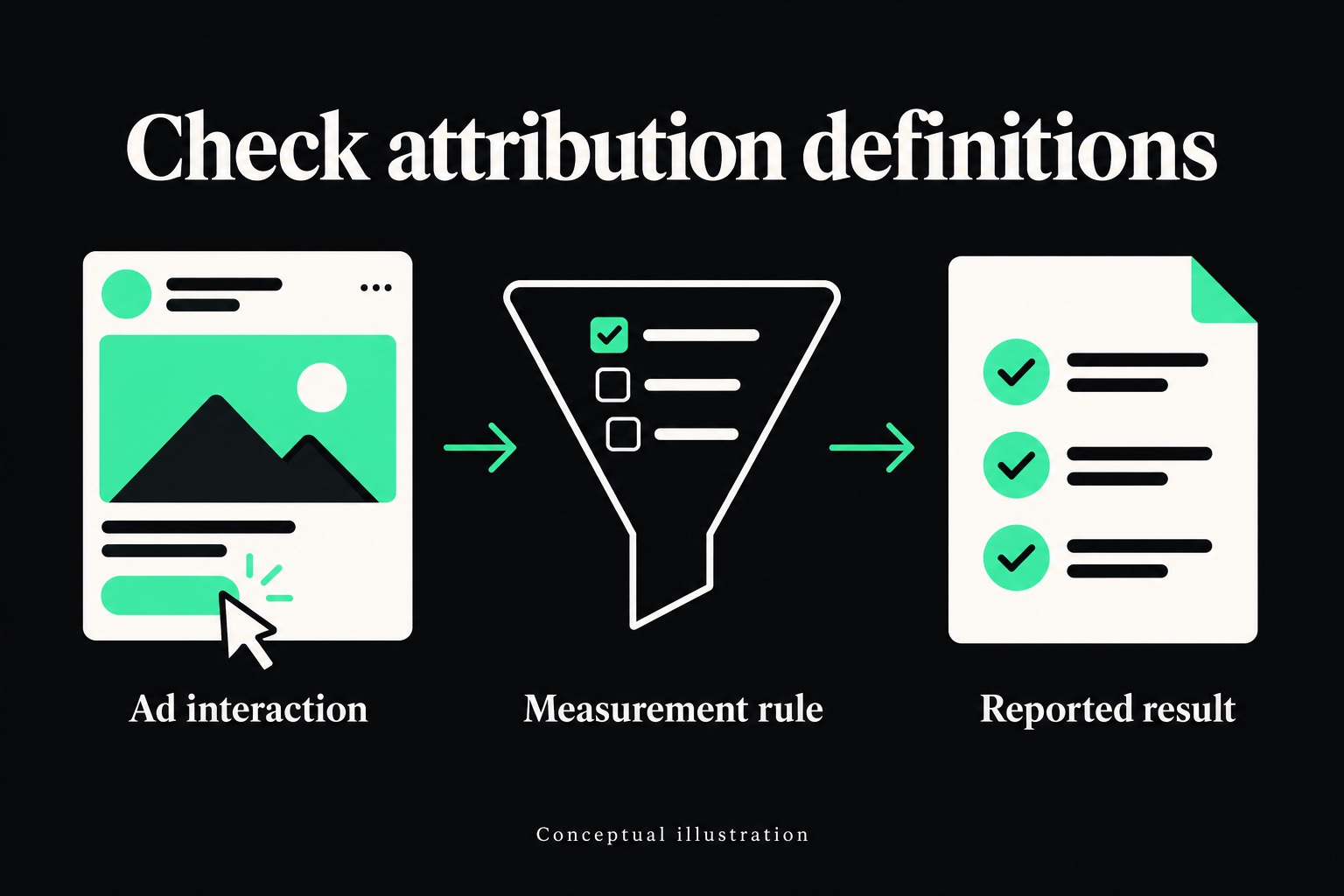
Meta's click-through attribution change now limits click-based credit to conversions that follow an actual link click. Everything else, a reaction, a share, a saved post, moves into a separate engage-through category instead. The shift is a definition change, not a performance change, but it shows up in Ads Manager as a number that moved. Here is what changed, why reported conversions can drop even when nothing else did, and what to check in every account before drawing conclusions from the new figures.
What Meta actually changed
For years, Meta's click-through attribution counted a conversion after any click on an ad. A link click counted. So did a like, a comment, a share, or a save. Starting in March 2026, that stopped. Click-through attribution now requires a click on a link: a website, an app store or app deep link, a lead form, click-to-call, click-to-message, and a short list of similar link types Meta groups under the same definition.
Everything that used to count toward click-through but was not a link click moved into a renamed category. Meta had called this engaged-view attribution, and it only covered someone watching a video for a few seconds before converting. The renamed version, engage-through attribution, now covers both that old engaged-view behavior and every non-link click that used to ride along inside click-through. It now applies across every ad format, a broader reach than the video-only engaged-view it replaced, which matters most for campaigns built around Reels, where engagement often happens without a link click at all.
Scroll sideways to see all columns.
| Interaction | Counted before March 2026 | Counted from March 2026 |
|---|---|---|
| Link click (website, app, lead form, click-to-call) | Click-through | Click-through |
| Reaction, comment, share, or save | Click-through | Engage-through |
| Video watched briefly, then a conversion | Engaged-view | Engage-through |
| Attribution window for the non-link activity above | Up to 7 days, inside the click window | 1 day only |
Why a lower number does not mean lower performance
Some conversions did not just move columns. They vanished. Engage-through carries a one-day window, where the old click-through window ran up to seven days for the same non-link activity. Someone who reacted to an ad on a Monday and bought on a Friday used to count as a click-through conversion. Now that purchase has nowhere to land: no link click happened, and the reaction is outside the one-day engage-through window. It drops out of both columns.
Open Compare Attribution Settings or Breakdown by Attribution in Ads Manager for one active campaign and check how its conversion volume splits between click-through and engage-through today. Remarketing campaigns are worth checking first. That is where a non-link engagement followed by a later, unrelated conversion showed up most often under the old rules, so the gap between old and new reporting tends to be widest there.
Accounts that had engaged-view, now engage-through, switched off entirely lose those conversions outright. There is no fallback column to catch them anymore. If a client's account runs lean with most non-click attribution turned off, expect its reported click-through numbers to have moved the most.
What this means for an agency
The first problem is inventory. Most shops do not have a current list of which ad sets keep engage-through on or off, or which client accounts lean hardest on remarketing audiences where this shift lands. That list is worth building this week, before a client asks why the numbers moved.
The second problem is comparability. Any month after March 2026 does not trend cleanly against a month before it in an account with real non-link engagement. Treat March as a line in the account's history and set new baselines from there instead of trending straight through it.
The third problem is automation. A rule, bid strategy, or dashboard built to key off click-through conversion counts is now reading a narrower definition than the one it was built against. A rule written to pause an ad set below a certain click-through count may trigger on volume that has not actually changed, only moved columns or dropped out of the one-day engage-through window.
The fourth problem is the client conversation. A client who opens Ads Manager and sees fewer click-through conversions than last quarter will ask why. The agency that already sent a note explaining the shift looks like it is watching the account. The one that has not looks like it found out at the same time as the client.
What clients will notice day to day
A client does not read Meta's newsroom. A client reads their own dashboard, and in an account with real social engagement, the click-through column can read noticeably lower than it used to, in a month where the campaign spent and performed the same as before.
Billing does not change. Meta was explicit that this update touches reporting and attribution only. What an advertiser pays for delivered ads stays the same. That is a useful, concrete line to give a client who worries a lower number means wasted spend: the campaign did the same work, and the report is counting it differently now.
Return on ad spend and cost-per-result figures calculated only against click-through conversions will look a step down for the same reason. Any client-facing report that quotes those figures without naming the definition change reads as a performance problem that is not actually there.
The checklist to run this week
- Pull current click-through and engage-through conversion counts for every active campaign and set that as the new baseline going forward.
- Check whether engage-through attribution is switched on in each ad set. Accounts that switched it off lose those conversions outright instead of seeing them move to a different column.
- Flag every automated rule, bid strategy, or reporting dashboard that keys off click-through conversion counts, and confirm it still does what it was built to do.
- Review remarketing campaigns first. This is where the gap between old and new reporting tends to be widest.
- Open Compare Attribution Settings or Breakdown by Attribution in Ads Manager on one live campaign to see the actual split between click-through and engage-through.
- Send clients a short note explaining the shift before they open their own dashboard and ask about it first.
Frequently asked questions
Does the change apply to every campaign?
No. It applies to click-based attribution for campaigns optimizing toward website or in-store conversions, the setting most agencies use for lead and purchase goals. It does not change how spend itself is measured or billed elsewhere in the account.
Did billing change along with the reporting?
No. Meta stated the update changes attribution and reporting only. What an advertiser is charged for delivered ads has not moved.
Should engage-through attribution stay on or off?
For purchase-goal campaigns, keeping the one-day engage-through window on is generally worth it, since it reflects real interest even when the eventual sale happens through another channel. For lead-goal campaigns, where a reaction or a save without a form fill says less about intent, turning it off account by account is a reasonable test.
Attribution definitions do not stay fixed, and this will not be the last one Meta rewrites. Saving a baseline and sending the client note early turns a definition change into a routine Tuesday task rather than an anxious client call.
Skayze builds changes like this into the reporting cadence for every account we run, before they turn into a surprise on someone's dashboard. See how we work.
Sources · 3
- Click attribution update — Meta's official announcement, Mar 3, 2026. Link-click-only definition and the engage-through rename.
- Click-through attribution now requires a link click — Jon Loomer, Mar 3, 2026. Default setting behavior and which conversions disappear.
- How Meta Ads attribution works — Jon Loomer. Evergreen attribution reference.
Adrian Vale
Meta Marketing API v26 migration: the agency checks
Plan Meta Marketing API v26 migration with verified deadlines, placement and creative checks, and a client handoff that catches silent configuration changes.
Instagram Reels post-view ads: what to test now
Instagram has rolled out Reels post-view ads, a placement that plays right after a video ends. What the format does, and how to test it before a client asks.
Product value optimization: Google Ads beta checks
Google Ads product value optimization lets retailers signal product priorities. Check the beta's scope, agree on client goals, and plan a measured agency test.